Monday, September 30, 2013

Fat Cat Gets a Passport

In preparation for our flight back to the US in December, Sam got a passport. This is not a sign of us going over the deep end--we're flying out of Paris, and all pets in the EU are required to have a pet passport for cross-border travel, so 38 Euros later Sam is now in the system :) And according to the system, she is a German cat!
The vet around the corner from our house filled it out using Sam's US paperwork--all of the vets and assistants dropped by the exam room to see her interesting American records. I was much more impressed with the EU-Pass, though. (Side note: Although the front says 'Heimtierausweis', the Germans just refer to it as der EU-Pass (said 'eh-oo pass'). This was yet another give-away that I'm not a native speaker, if the accent and moderately poor grammar didn't make it clear!) The passport includes pages for identifying information (owner, breed and coloring, microchip number and injection site) as well as vaccinations. There are also pages for health certifications, which is a great improvement over the pages and pages of certified documents that were required to get her over here! The passport lasts the lifetime of the animal, so as long as we keep it updated Sam can travel in the EU again with (theoretically) less hassle.

Saturday, September 28, 2013

More Fun with Johannisbeeren

I promised another Johannisbeeren (aka, fresh currant) recipe, and this one is a winner. I picked this recipe because it's very similar to what's often sold in bakeries and it includes another of our favorite German ingredients, quark.
Quark is a type of fresh cheese, with a consistency between sour cream and cream cheese. It's a bit sweeter than sour cream, but not as thick as (and a bit drier than) cream cheese. We most often see it in desserts like cheesecake and custard, but it's also used to make bread, spreads, dips, and more. For anyone who can't find quark, I have heard that Greek yogurt or drained yogurt are decent substitutes. For this recipe, I think sour cream would work well in the base and cream cheese would work for the filling, but the only way to know for sure will be to do extensive testing once we're back in the States. :)
Johannisbeer-Quarkkuchen
original recipe
Base
1/4 cup (150g) quark
6 tablespoons milk
6 
tablespoons oil
1/3 
cup (75g) sugar
2 t (1 packet) vanilla sugar
pinch salt
2 1/2 cups (300g)
 flour
3 3/4 teaspoons (1 packet) baking powder
 
1. Mix the quark, milk, oil, sugar, vanilla, and salt. In a separate bowl, mix the flour and baking powder.
2. Mix half of the flour mixture into the quark mixture until almost combined, then add in the rest of the flour and gently mix til fully combined.
3. Dump the dough into a greased baking dish (11x7 or 13x9) and gently pat it down til it's evenly spread.
Topping
~2 c (750g) fresh currants
1 
cup (750g) quark
1 cup (200g) sugar
1-2 
teaspoons (1 packet) vanilla sugar
3 eggs
2 eggs, yolks and whites separated
4 T (50g) butter, soft or melted
1/2 cup minus 2 
tablespoons (50g) cornstarch
1/3-1/2 cup (100g) sugar
slivered almonds to cover the top (20g)
1. Mix the quark, 1 c sugar, vanilla, 3 whole eggs, 2 egg yolks, and butter til smooth. Then mix in the cornstarch and stir til smooth and thick.
2. Wash and dry the currants, and remove them from their stems. Mix the berries with the quark mixture.
3. Dump the berry-quark filling onto the base and spread it til smooth.
4. Bake at 400F/200C for 25-50 minutes, or until the center isn't too jiggly. (My pan was a bit small, so the filling was thicker and thus needed to cook longer.)
5. While the filling is baking, whip the 2 egg whites until very stiff. Then gently fold in the sugar.
6. Remove the pan from the oven and (while it's hot) spread the egg whites evenly over the top. Then sprinkle slivered almonds over the top of that, using enough almonds to almost completely cover the egg whites.
7. Bake at 400F/200C for another 5 minutes or until the almonds are toasted.
I made a half recipe, which fits in the equivalent of a 8x8 or 9x9 pan
The recipe looks much more complicated than it actually is--it comes together in about an hour. And, anyway, it is worth the effort!

Tuesday, September 24, 2013

Modern Art in Venice

While wandering around Venice and soaking up all the beauty of the moldering city and its canals, we noticed a lot of art--not just museums with works by the old masters, but also a lot of modern art. The Venice Biennale is a contemporary art exhibit that's been going on since 1895, and the associated exhibits scattered all over the city and surrounding islands contrast in really interesting ways with the old buildings and winding canals. Some of them were really neat, and some of them were rather avant garde (i.e., strange). There are a few that I particularly remember...

On the walk to our apartment, our guide pointed out an art installation just down the street from our apartment. I was interested in checking it out until she told us that the installation was primarily composed of walls covered in the skins of white lab rats. We skipped that one and so I don't have any pictures, but if you're curious you can check it out. This was by far the strangest one we [almost] saw, though I heard that in an exhibit somewhere else in Venice you could see a self-portrait sculpture made out of the artist's frozen blood...which might qualify is as weird or weirder.
waterbus ride!
At the advice of our guide, we left the crowds behind and caught a waterbus to the island of San Giorgio. Before we even got to the island, we noticed that it was home to some pretty eye-catching art.
source

Friday, September 20, 2013

Nippes, Lately

new box + warm heaters = happy cat
We have mostly been hanging around Cologne for the past few weeks, recovering from trips and vacations and catching up on work. Even though we aren't traveling, I try to capture small parts of our days that remind me that it's not just the same ol', same ol'. It's been quite chilly here, between 50 and 60F, so we have turned our heaters on low and pulled out our jackets. Even if it's 90 and humid in Boston, it feels like fall in Cologne! Here are a few shots from the past few weeks...
clockwise from top-left: a pre-war building in Nippes,
Moriz & Oskar (resident Pappageien at the botanic gardens),
fresh, tart wine grapes from a neighbor's garden,
clevery defaced campaign sign (from 'together successful ' to 'alone/a few rich'),
signs of Oktoberfest reach our local department stores, and
a sunset from our rear window

Tuesday, September 17, 2013

Exploring New Ingredients


The open-air market around the corner from our house is such a fun place to discover new fruits and vegetables in each season. Many fruits, veggies, and grains that are 'gourmet' and uncommon in the US are very common here, so I have been trying out new ingredients that would otherwise be too expensive. Lots of lovely fruits and veggies come in from Italy and Turkey, including beautiful figs that arrived in the markets a couple weeks ago. Goat cheese is quite cheap, so I have been enjoying decadent fig, goat cheese, and honey snacks!

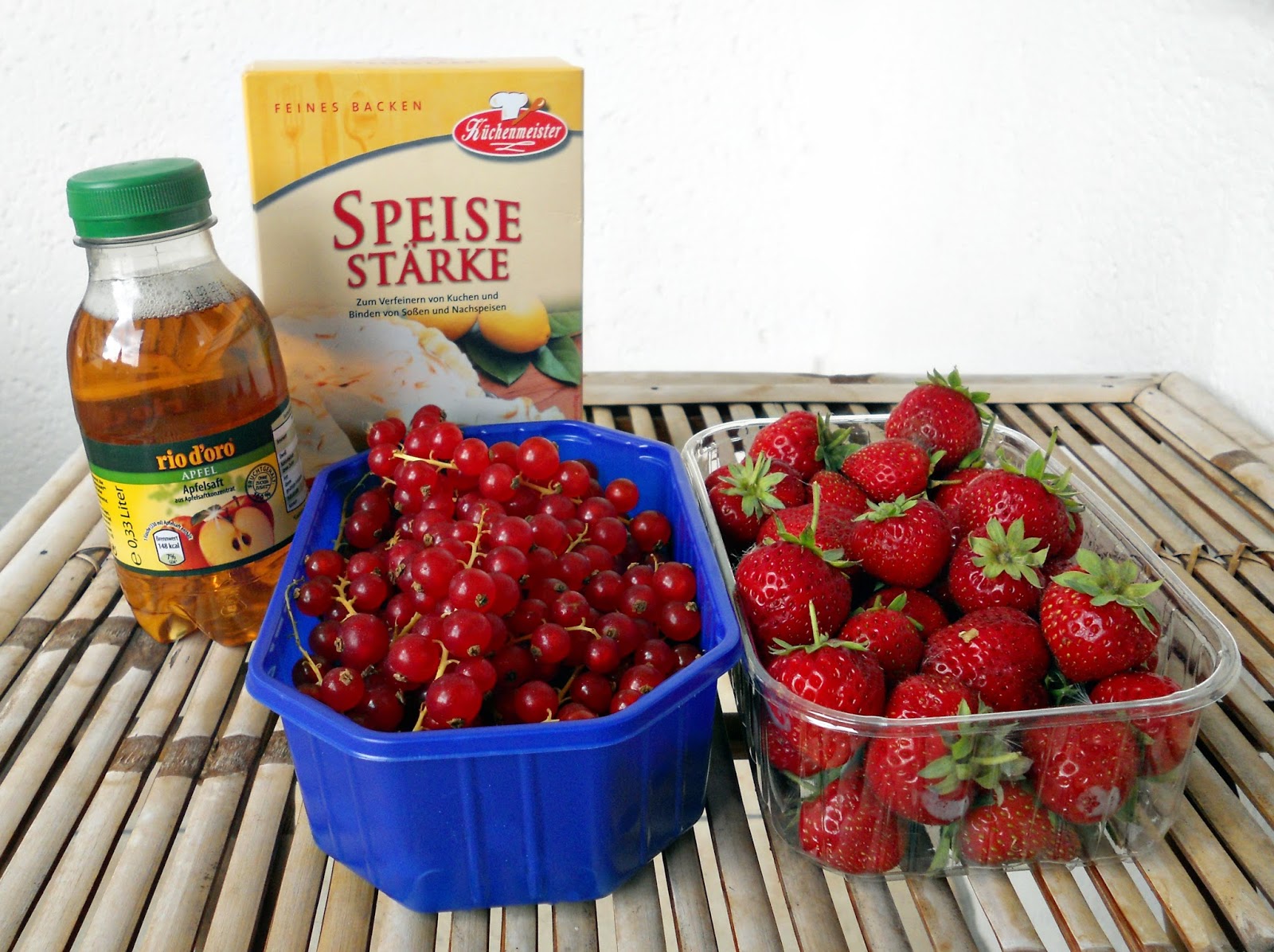
But today I'm not writing about figs. Instead, I want to talk about Johannisbeeren, one of my summer fruit discoveries. I have never seen these berries in the US, but here they are a common garnish and ingredient. The berries are a very pretty bright red, and slightly translucent. They taste tart, but not sour. I have been snacking on them since late July, but this week I finally decided to check out some recipes.
tiny, sweet  Erdbeeren + tart Johanissbeeren
While searching for recipes, I also looked up the English name for these berries. It turns out that they are currants! I have tried dried currants from the Turkish grocery store around the corner, but they pretty much taste like raisins. I vaguely remember tasting fresh currants in my agroforestry class at Cornell in 2006, but I have never seen them in a US grocery store.

I found a bunch of interesting recipes using fresh Johannisbeeren, but I decided to first try out the simplest: Rote Grütze, a traditional North German fruit 'pudding.'
Rote Grütze means 'red grits.' My reading indicates that it was made with just grits and fruit juice in the past. Modern recipes vary in the number of ingredients and difficulty, but they no longer include grits and the base recipe always includes at least two types of whole berries, fruit juice (or wine), and a thickener. The recipe I tried is a really easy: there are only 4 ingredients, and it takes maybe 20 minutes active cooking time, plus an hour for the pudding to cool.

Rote Grütze
400 grams/~3.5 cups (total) at least 2 types of red berries (currants, raspberries, sour cherries, strawberries)
400 ml/1.5 cups fruit juice (apple, cherry, grape, cranberry, whatever you like!)
8 teaspoons corn starch or semolina
~1/4 cup sugar, more or less to taste
1.   Wash the berries. In a medium-sized pot, cook them over medium heat for about 3 minutes. Then add the juice and cook for another 3 minutes. Add the sugar and stir to dissolve. Taste it and add more sugar if you like it sweeter.
2.   Lightly mash the fruit with a spoon. Mix the cornstarch with a bit of water to make a thick slurry, then slowly add the slurry to the pot while stirring.
3.   Cook for another 3-5 minutes, til the mixture thickens a bit. Remove the pot from the heat. Pour the mixture into 4 serving bowls or a jello mold, and let it come to room temperature before placing it in the fridge for an hour to solidify. It will have the consistency of thick preserves.
4.   Serve the traditional way, with milk or vanilla sauce, or try it with chocolate cake or on your morning yogurt!
Some recipes include a vanilla bean or a splash of red wine, cherry liqueur, or rum, which I might try next time. The berry season is just about over, so I made a half recipe and used currants and strawberries. I served it with 5 ingredient chocolate cake and vanilla sauce -- it is cool and not too sweet, which makes it a perfectly refreshing summer dessert!

Look for another Johannisbeere recipe coming soon!